向量財管 VectraFin
向量財管 VectraFin 是一款以「時間對位」與「Hashtag 階層鏈」為核心的個人財務管理 App,讓使用者用自己的邏輯記帳、清點資產、追蹤負債,並探索未來財務趨勢。
- 可用裝置
- iPhone / iPad
- 下載方式
- 付費下載
產品定位
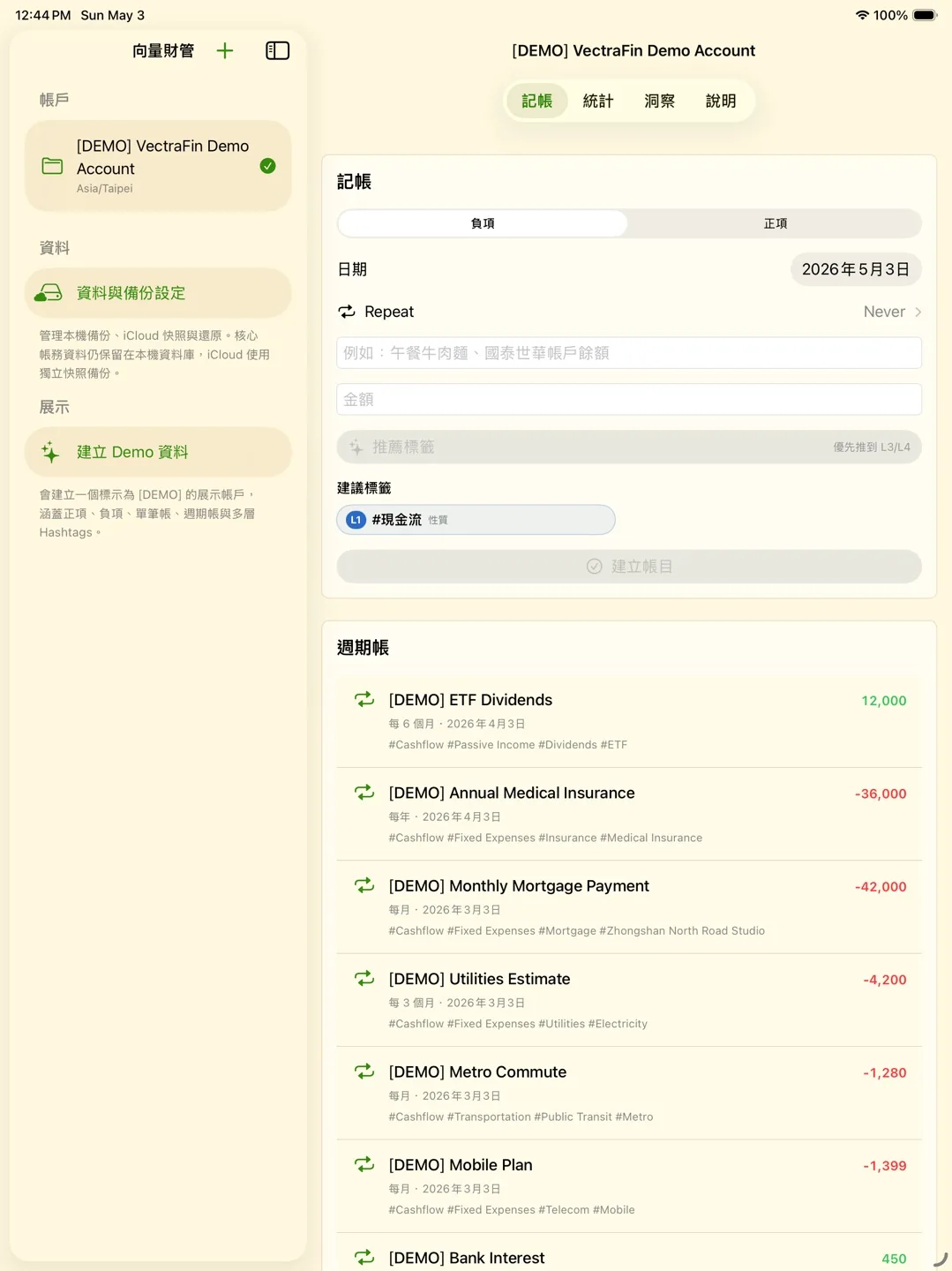
VectraFin 不是傳統預設分類式記帳本,而是一套更彈性的財務紀錄工具。每筆金額只需要先判斷方向:正項代表增加,負項代表減少;至於它是資產、負債、現金流、估值調整或生活支出,則交由使用者自定義 Hashtags 表達。
這讓記帳不再被固定分類限制,而能貼近每個人理解財務的方式。
核心特色
- 正項 / 負項模型:每筆帳以金額方向為核心,正項代表財務增加,負項代表財務減少。資產、負債、收入、支出、估值調整等概念都可以透過 Hashtags 彈性描述。
- Hashtag 階層鏈:使用者可以用多層 Hashtags 建立自己的分類邏輯,例如
#資產 #銀行帳戶 #國泰世華或#現金流 #生活費 #伙食費 #牛肉麵。系統能從大分類一路往細節探索,讓統計像「粗水管包細水管」一樣自然展開。 - 時間對位統計:VectraFin 特別重視「現在」與「未來」的差異。查看目前資產時,只計算已經發生的資料;查看未來趨勢時,才把週期帳展開為預測。
- 週期帳向後生效:週期帳可用於薪資、房租、訂閱、貸款等規律金流。修改或停止週期帳時,只會影響生效日之後,不會改寫過去已經對位完成的紀錄。
- 統計與視覺化:可依 Hashtag、時間區間與查詢模式進行統計,支援階層分解、圓餅式結構分析、趨勢圖與明細檢視。
- 本機優先與 iCloud 同步:資料預設保存在使用者裝置上。使用者可選擇本機備份、iCloud 快照或 iCloud 同步;不需要註冊帳號,也不需要建立外部伺服器。
- 多帳戶管理:App 內可建立多個獨立帳戶,每個帳戶有自己的 Hashtag 體系。帳戶可刪除,刪除時會清楚提示該帳戶的過去、現在與未來資料都會被移除。
- 多語系準備:VectraFin 已以多語系架構設計,適合作為全球市場的個人財務工具基礎。
設計理念
傳統記帳 App 常要求使用者先選擇固定分類,但真實生活裡,財務項目常常模稜兩可。VectraFin 採用 Hashtag 階層鏈,讓使用者可以先用大分類掌握方向,再依照需要逐步補充細節。
當沒有時間仔細分類時,停在大項目也可以;當需要深入分析時,則能一路往細節探索。這種方式更接近人類理解問題的自然路徑。
VectraFin
VectraFin is a personal finance app built around time alignment and hierarchical hashtag chains. It helps people record transactions, review assets, track liabilities, and explore future financial trends using their own logic.
- Devices
- iPhone / iPad
- Download
- Paid download
Positioning
VectraFin is not a traditional bookkeeping app built around preset categories. It is a more flexible financial record system. For each amount, users first decide its direction: a positive amount represents an increase, and a negative amount represents a decrease. Whether that amount is an asset, liability, cash flow, valuation adjustment, or living expense is expressed through user-defined hashtags.
This keeps bookkeeping from being trapped inside fixed categories and lets each person describe money in the way they actually understand it.
Core Features
- Positive / negative amount model: Each record starts with the direction of the amount. Positive amounts represent financial increases, while negative amounts represent financial decreases. Assets, liabilities, income, expenses, and valuation adjustments can all be described flexibly with hashtags.
- Hierarchical hashtag chains: Users can build multi-level classification logic with hashtags, such as
#Assets #BankAccount #CathayUnitedBankor#CashFlow #LivingCosts #Food #BeefNoodles. Statistics can move naturally from broad categories into fine details. - Time-aligned statistics: VectraFin treats "now" and "future" as different questions. Current asset views only count records that have already happened; future trend views expand recurring entries into forecasts.
- Forward-effective recurring records: Recurring entries can represent salary, rent, subscriptions, loans, and other regular cash flows. When a recurring entry is modified or stopped, only dates after the effective date are affected, preserving historical records that were already aligned.
- Statistics and visualization: Users can analyze finances by hashtag, date range, and query mode, with support for hierarchical breakdowns, pie-style structure analysis, trend charts, and detail views.
- Local-first data and iCloud sync: Data is stored on the user's device by default. Users can choose local backups, iCloud snapshots, or iCloud sync without creating an account or relying on an external server.
- Multiple account spaces: Users can create independent accounts inside the app, each with its own hashtag system. Deleting an account clearly warns that its past, present, and future data will be removed.
- Built for localization: VectraFin is designed with a multilingual architecture, making it suitable as a foundation for a global personal finance tool.
Design Philosophy
Traditional bookkeeping apps often ask users to choose fixed categories first, but real financial life is frequently ambiguous. VectraFin uses hierarchical hashtag chains so users can start from a broad category and add detail only when they need it.
When there is no time for careful classification, a broad tag is enough. When deeper analysis is needed, users can explore all the way down into the details. This approach is closer to the natural way people understand complex financial questions.