Spatial Electronics Lab app icon Apple Vision Pro · visionOS 1.0 已上架

把房間變成電子實驗室,親手理解一條電路為什麼會亮。

空間電子實驗室把虛擬電腦、相容開發板、麵包板與元件放到眼前。你可以直接拉線、上傳教學程式,再用按鈕、手電筒與即時波形看見電路反應。
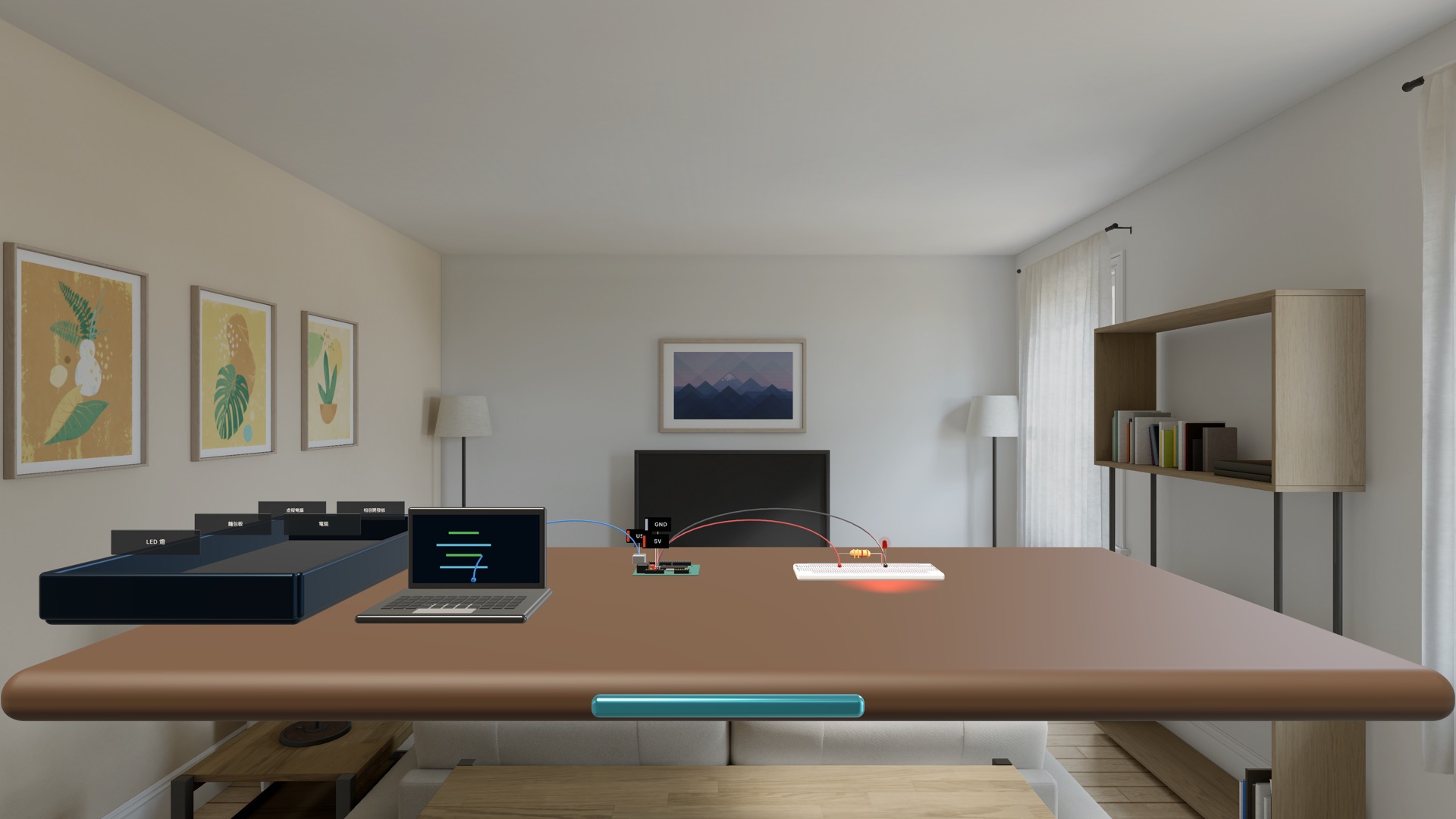
空間電子實驗室在 Apple Vision Pro 的房間中呈現虛擬電腦、開發板、麵包板與亮起的 LED
直接在空間中動手放大元件、移動工作台,將柔性導線吸附到有清楚名稱的腳位與孔位。
電路會立刻回應LED、按鈕、感測器、序列數值與波形會隨接線、程式與環境光即時改變。
不用先買實體零件先在教育模擬中理解供電、極性、輸入、量測、控制與常見錯誤,再決定是否進一步實作。
可用裝置
Apple Vision Pro
下載方式
免費兩課・後續內購

前兩課免費;一次性內購解鎖後續四課。

查看 App Store 的價格與相容性 ↗

不是看完影片,而是看一次、做一次,再獨立完成

每個主題先用有旁白的示範建立概念,再進入聚焦的逐步重建;吸附接線與即時檢查降低空間操作的負擔,但不代替判斷。最後的無提示挑戰要你自己完成目標,通過後仍可回到已完成課程複習。
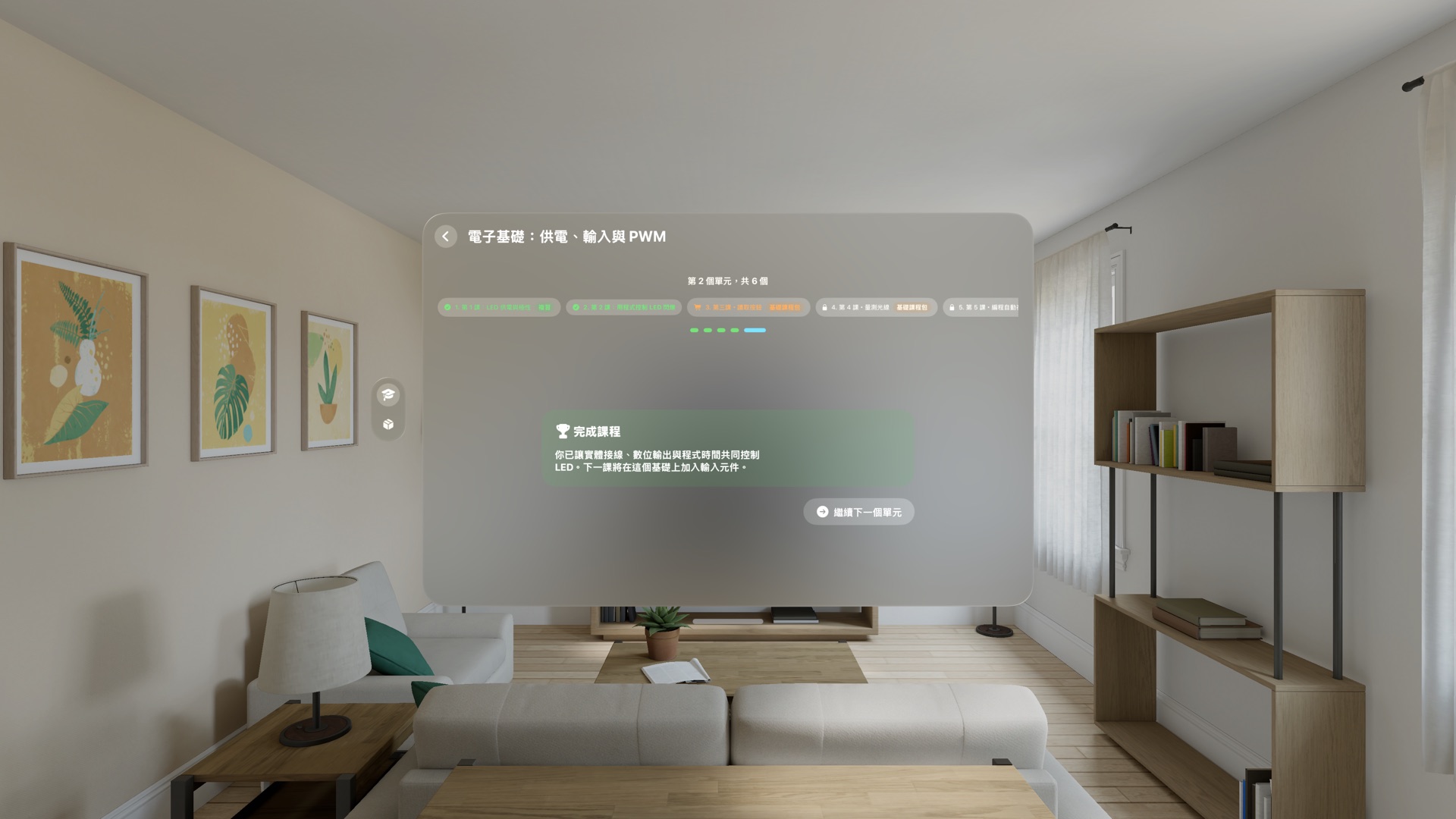
空間電子實驗室顯示六個課程單元、完成狀態與繼續下一單元按鈕
六課共用同一條進度路徑;完成的接線、量測與程式會成為下一堂課的基礎。

六課把單一 LED,逐步變成會感測環境的自動控制

1 · LED 供電與極性理解麵包板連通、LED 正負極、330 Ω 電阻與完整電流路徑。
2 · 用程式控制閃爍把 LED 交給數位腳位,經由虛擬 USB 檢查並上傳定時開關程式。
3 · 讀取按鈕加入四腳按鈕、共用接地與 INPUT_PULLUP,理解 active-low 輸入。
4 · 量測光線用光敏電阻建立分壓器,觀察亮暗讀值、即時波形並保存門檻。
5 · 編程自動夜燈把自己的量測範圍寫入控制邏輯,再用明暗循環驗證結果。
6 · 用 PWM 平滑調光把感測值映射成亮度,讓 LED 不只在全亮與全滅之間切換。
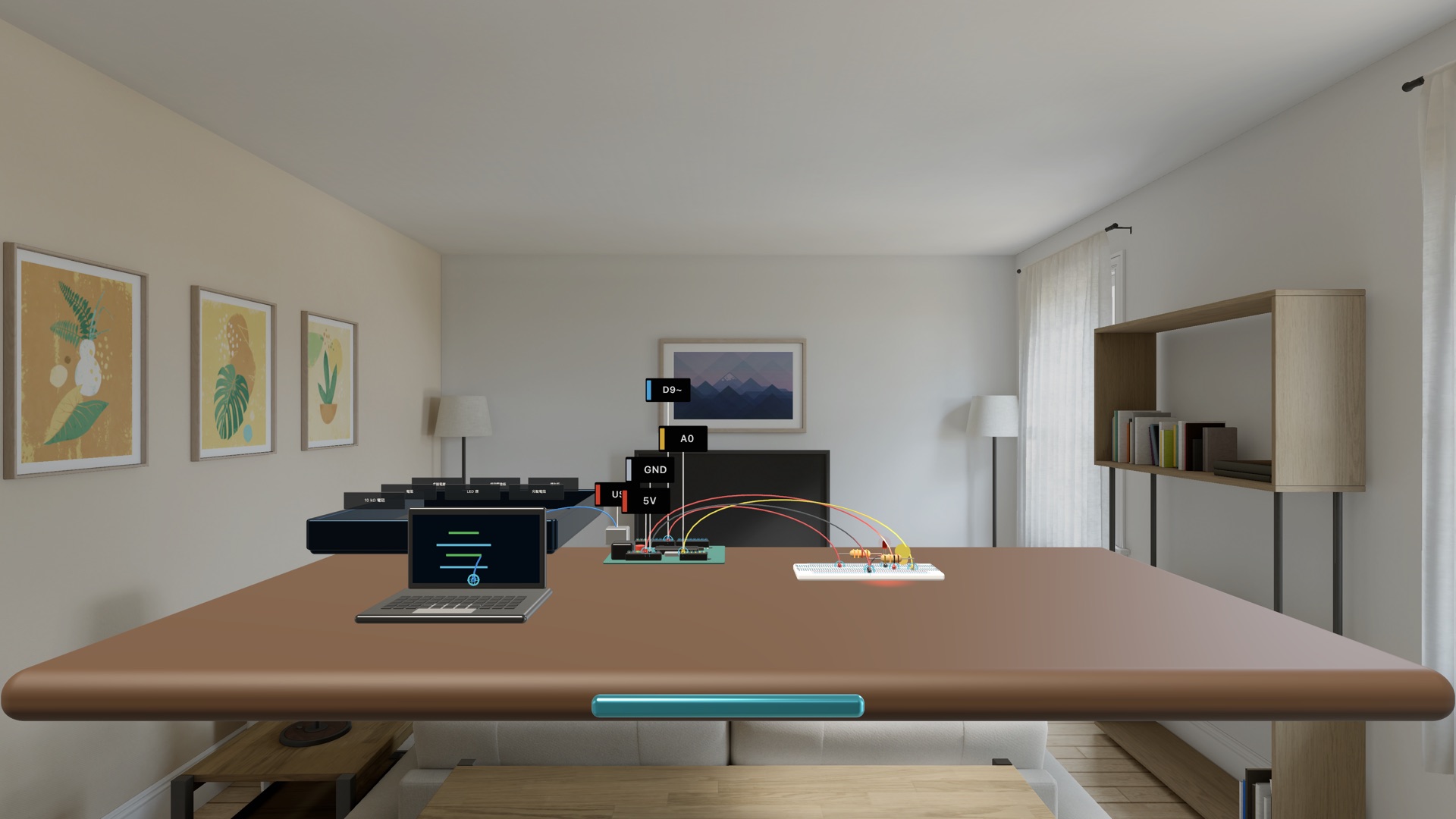
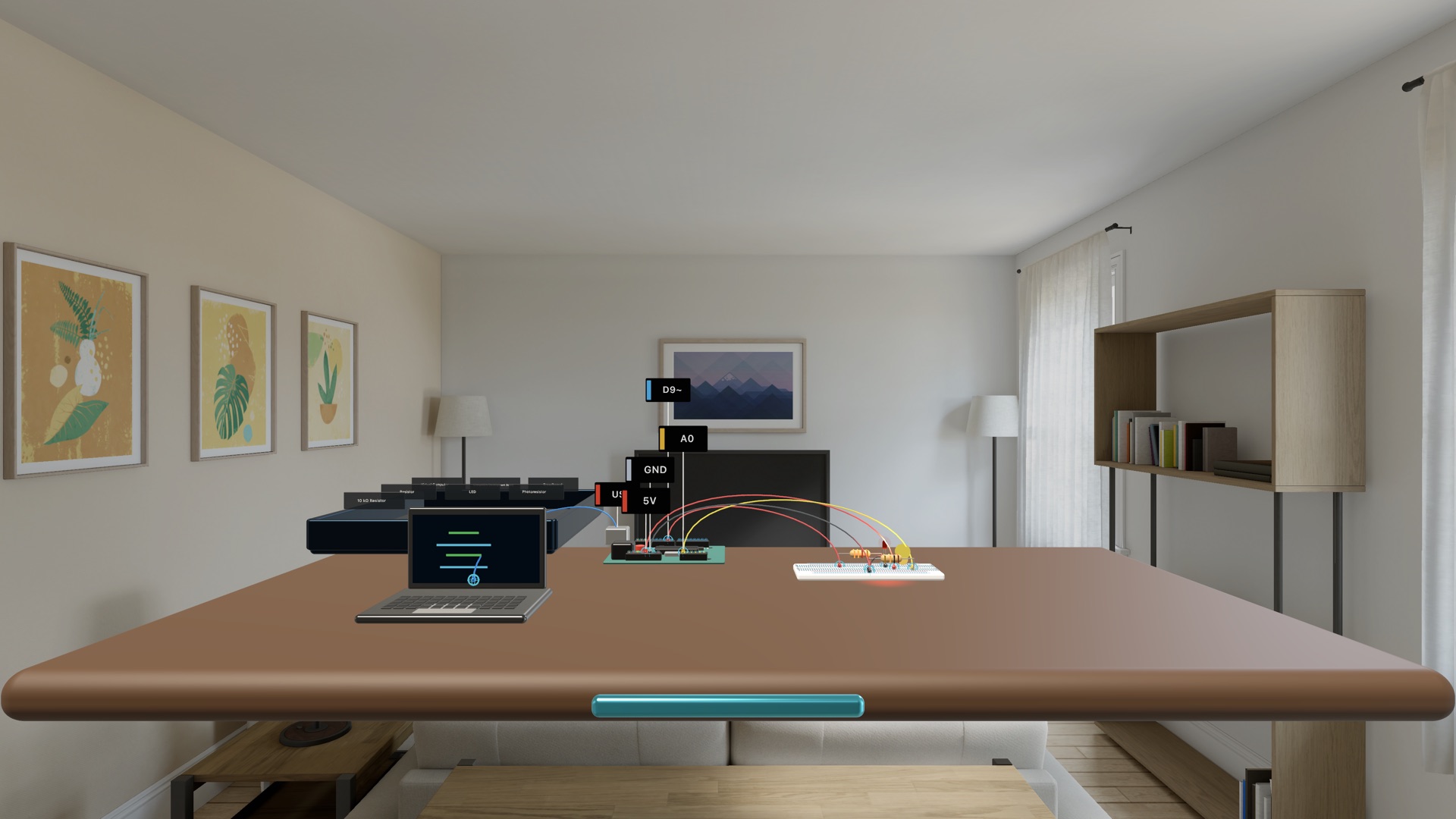
多條不同顏色的導線連接開發板與麵包板,腳位以 D9、A0、GND 與 5V 清楚標示
吸附接線與腳位標籤讓複雜接線仍可讀;需要時可聚焦單一物件、調整端點或使用復原。

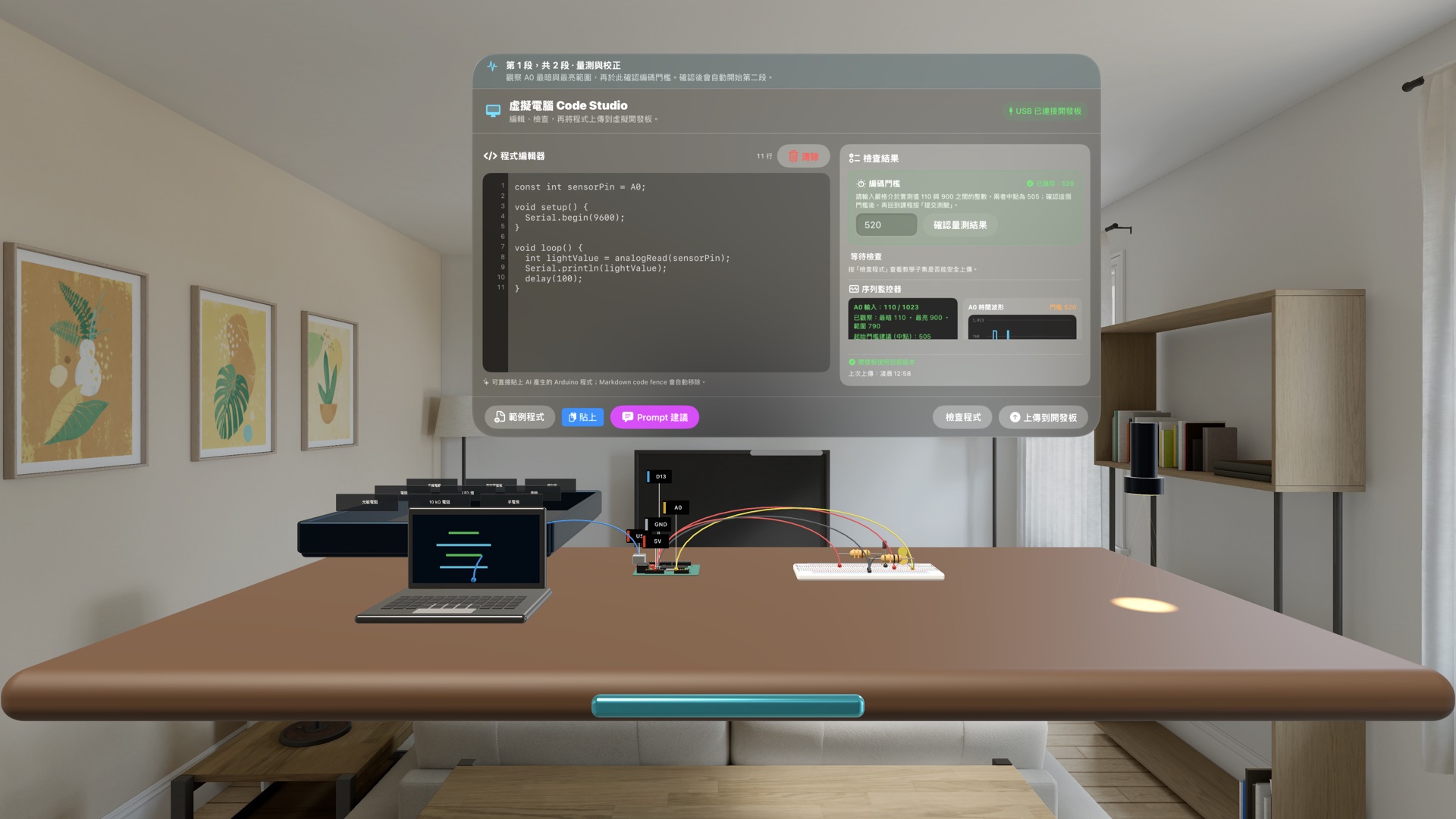
Code Studio 把草稿、檢查與上傳分開

你可以輸入或貼上微控制器風格的教學程式。草稿不會立刻改變電路;程式先經安全子集檢查,再由你明確上傳到虛擬開發板。診斷區、序列監視器、類比數值與 PWM 遙測,會把程式行為和桌面上的實際結果放在同一個視野裡。

Prompt 建議只會整理與目前課程相關的文字,方便你主動複製到外部 AI 工具;App 本身不連接外部生成式 AI,也不執行任意原生程式碼。貼回的內容會先移除說明文字與 Markdown 外框,再在裝置端檢查。
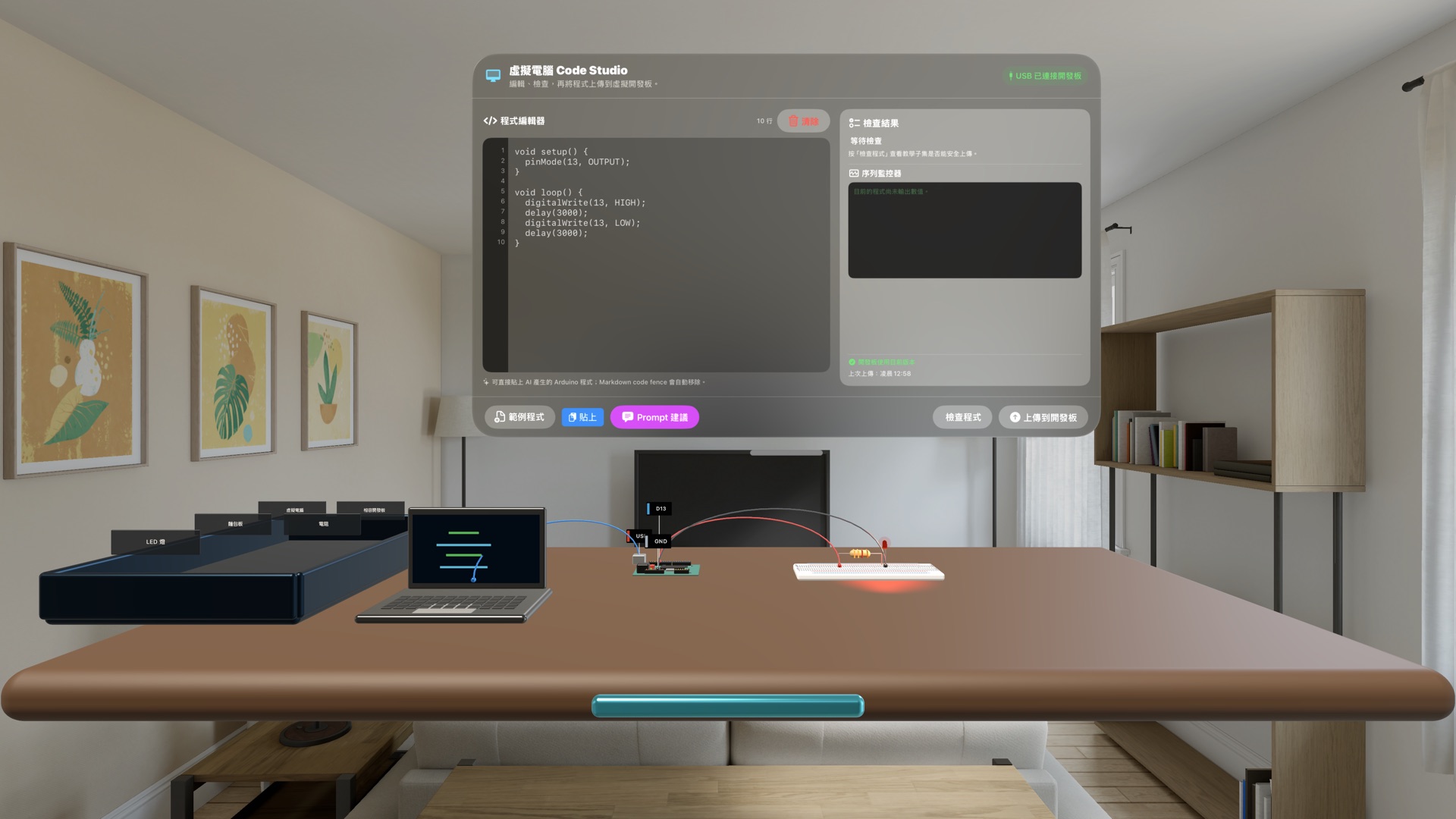
空間電子實驗室 Code Studio 顯示程式編輯器、檢查結果、序列監視器與上傳到開發板控制
編輯、檢查、上傳與執行是四個清楚步驟,讓初學者知道目前看到的是草稿還是正在運行的程式。

按鈕與感測器不是靜態模型,而是實驗輸入

按下空間中的按鈕,數位輸入與 LED 會直接反應;移動手電筒靠近或遠離光敏電阻,A0 數值、門檻判斷與波形會一起更新。學習者必須用實際觀察到的亮暗範圍完成校正,再把結果帶進夜燈程式。
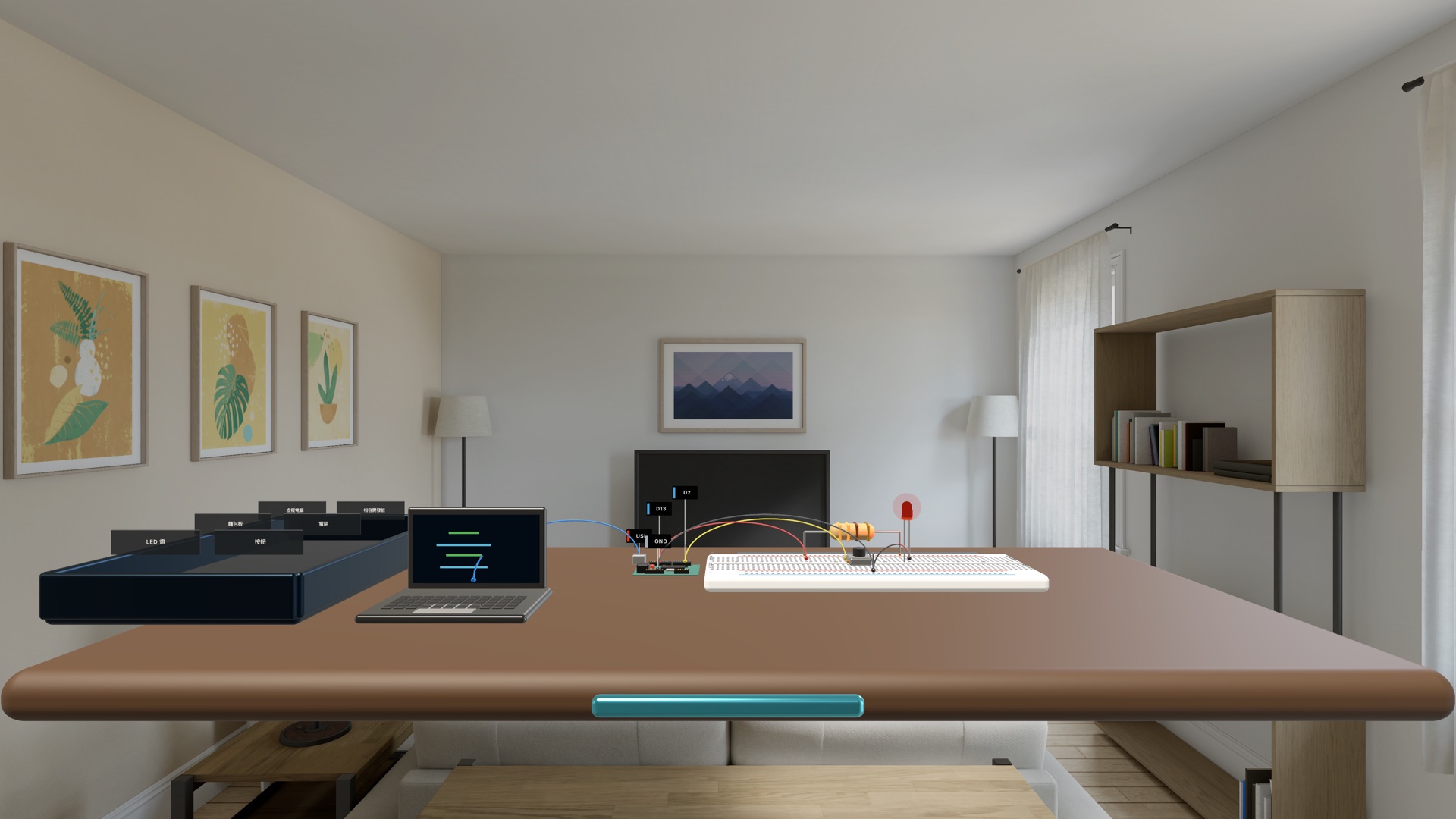
空間電子實驗室的按鈕電路,以導線連接按鈕、LED、電阻、麵包板與開發板
按鈕是可以直接操作的輸入,並與數位腳位、程式狀態和 LED 輸出連動。
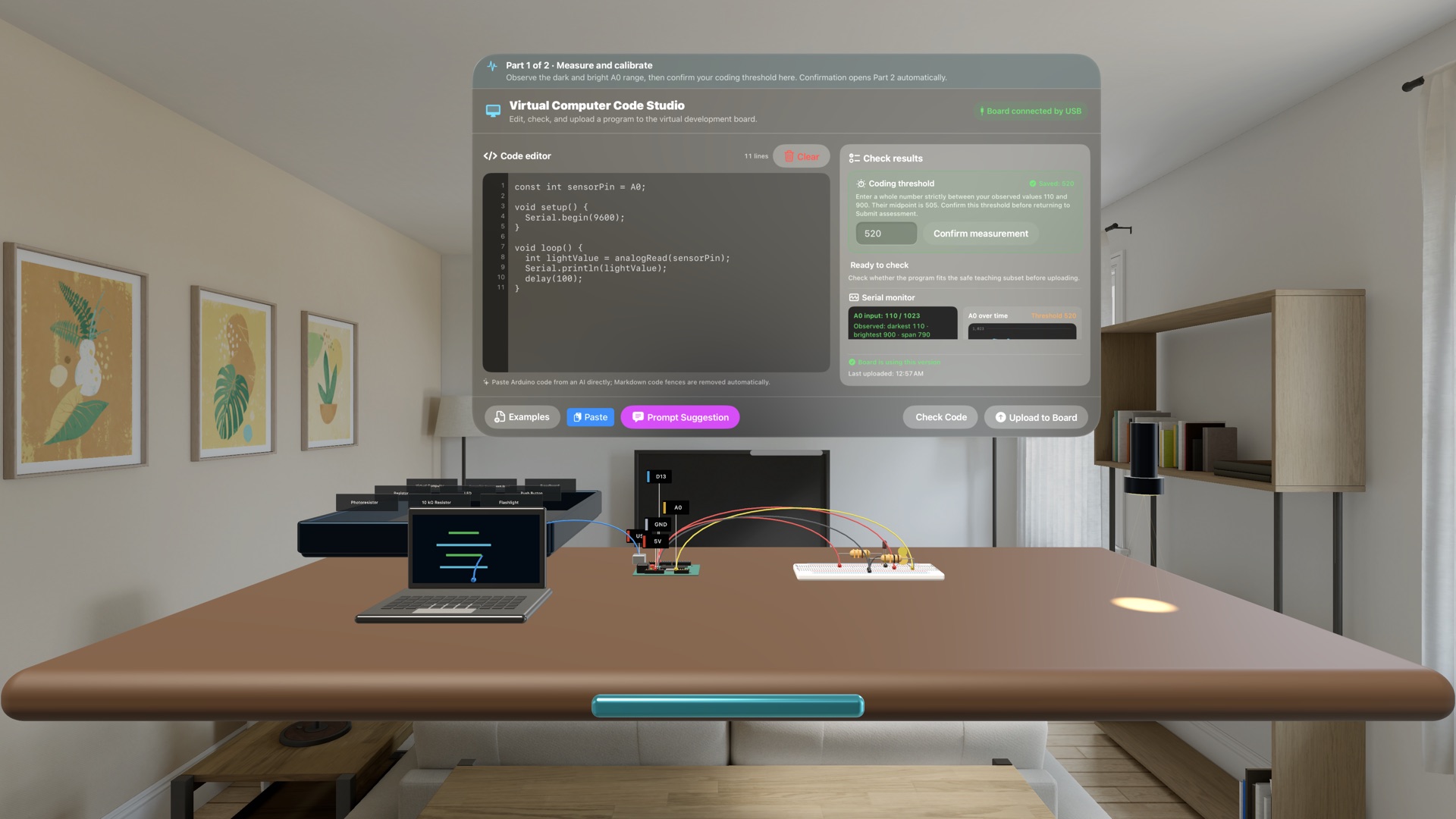
手電筒照射光敏電阻時,Code Studio 顯示 A0 讀值、校正範圍與即時波形
光線實驗同時顯示空間中的光源、感測器、數值與波形,讓量測不只剩下一個答案。

從課程走進自由實驗場與 3D 元件庫

元件庫收錄虛擬電腦、相容開發板、830 孔麵包板、跳線、電阻、LED、按鈕、光敏電阻、熱敏電阻與伺服馬達。每個元件都能在 3D 預覽中旋轉、放大並查看接點;自由實驗場則讓你自行取用材料、安排工作台與測試想法。
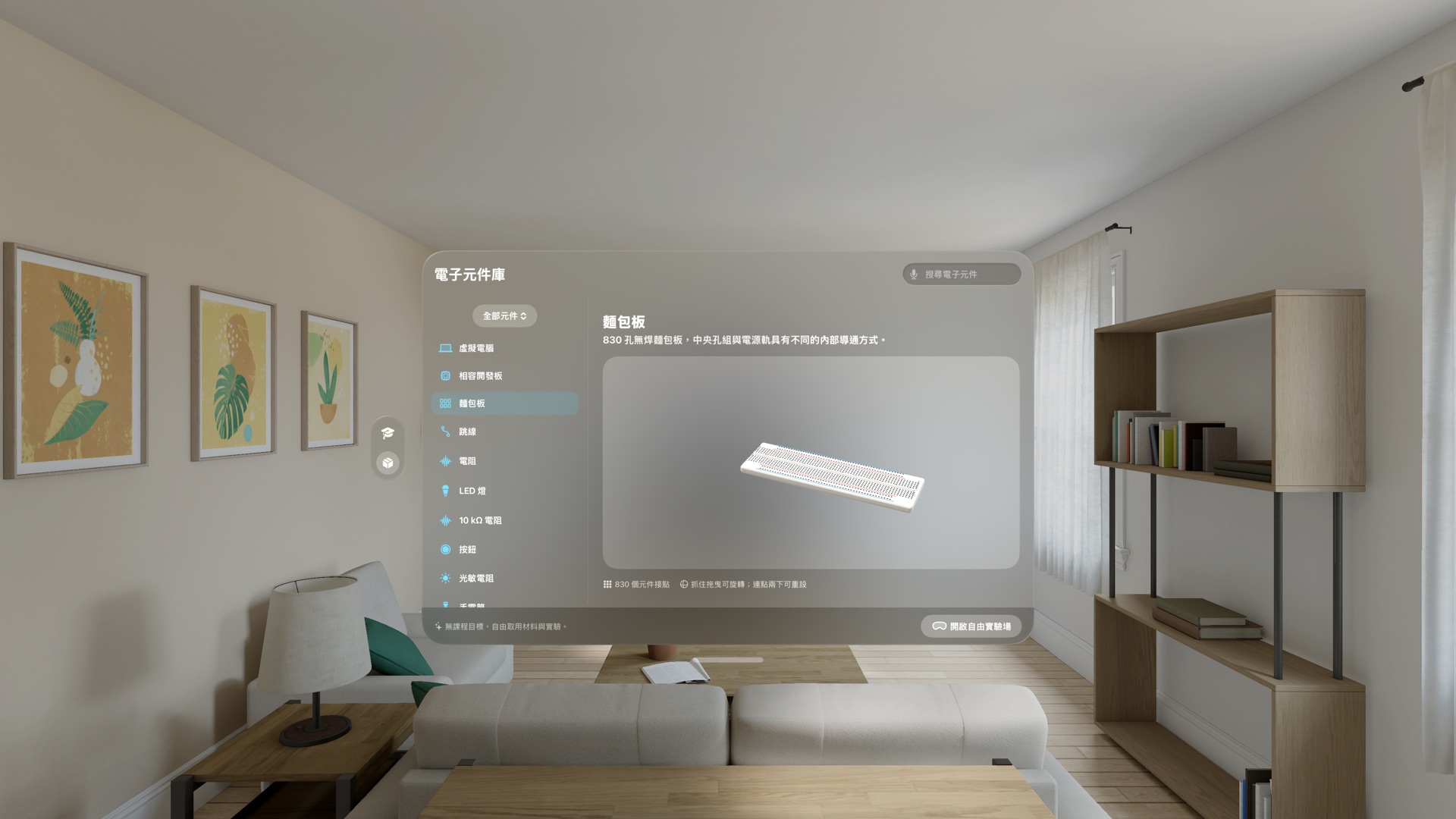
空間電子實驗室的電子元件庫顯示 830 孔麵包板與其他可搜尋的 3D 元件
元件庫把名稱、用途、接點與可操作 3D 模型放在一起,也可直接開啟自由實驗場。

錯誤會留下可觀察、也可復原的後果

模擬器依實際端點、麵包板連通、元件值、已上傳程式與實體控制重新計算。短路、極性反接、浮接輸入、錯誤腳位、非 PWM 輸出與 LED 過電流不只是答案提示:它們會改變電路狀態,並提供診斷、聚焦與復原工具。這是教育模擬,不會控制實體開發板,也不取代真實電氣安全訓練。

前兩課免費;一次買斷完整基礎課程

免費開始下載後可完成第 1 課「LED 供電與極性」與第 2 課「用程式控制 LED 閃爍」。
Foundation Course Pack一次性 App 內購買永久解鎖第 3–6 課,可隨時回來複習;沒有訂閱,並提供恢復購買。
11 種語言繁中、簡中、英文、日文、韓文、德文、法文、義大利文、西班牙文、巴西葡萄牙文與俄文。
本機學習資料不需要帳號、沒有廣告或第三方分析;學習者、進度、電路與程式草稿保存在裝置上。

Spatial Electronics Lab visionOS 1.0 已在 Apple Vision Pro 的 App Store 上架。免費下載並完成前兩課,再決定是否一次買斷後續基礎課程。

Spatial Electronics Lab app icon Apple Vision Pro · visionOS 1.0 now available

Turn your room into an electronics lab and learn why a circuit lights.

Spatial Electronics Lab places a virtual computer, compatible development board, breadboard, and components in front of you. Wire them directly, upload a teaching sketch, then use buttons, a flashlight, and live waveforms to see the circuit respond.
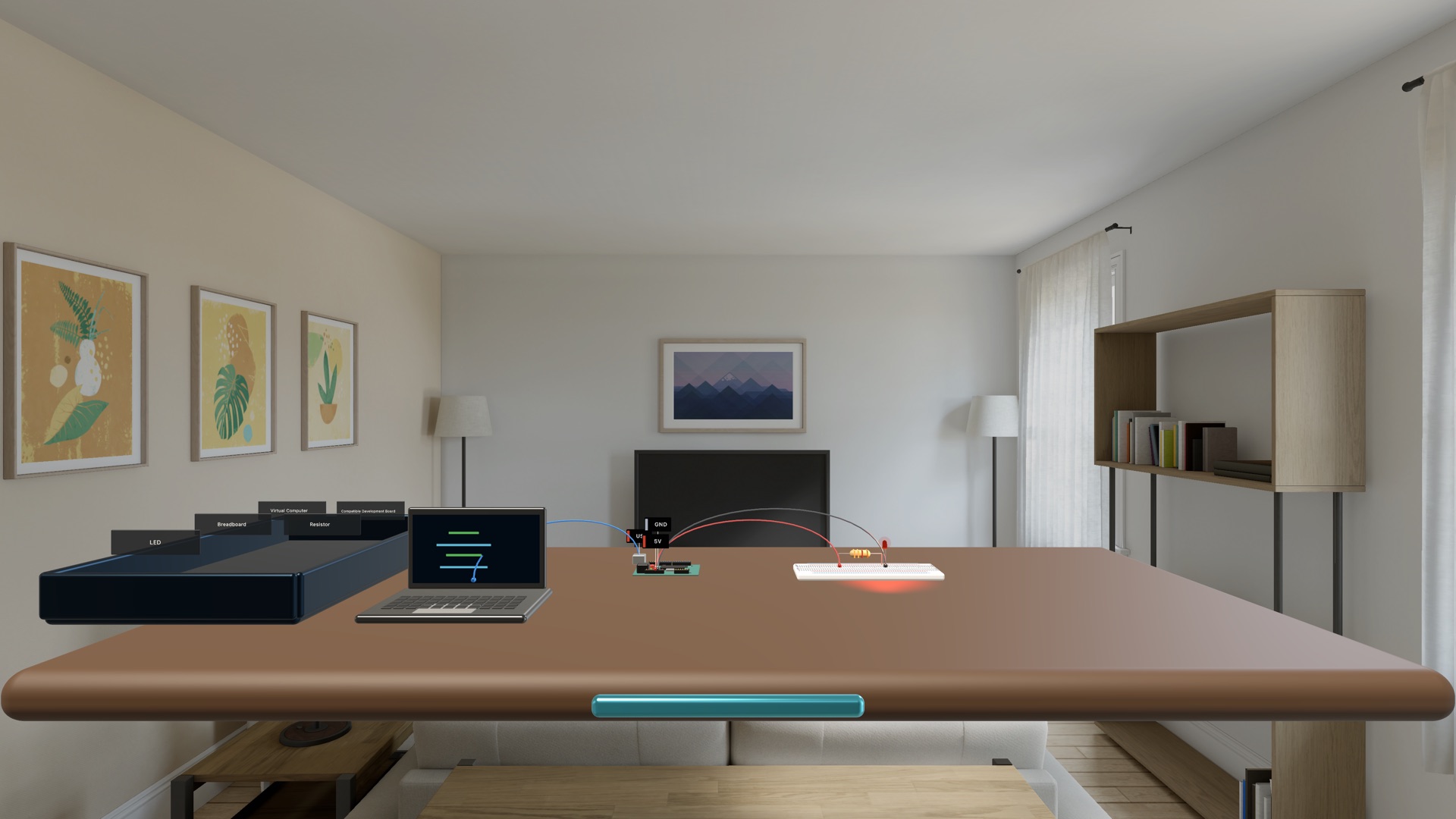
Spatial Electronics Lab showing a virtual computer, development board, breadboard, and lit LED inside a room on Apple Vision Pro
Build directly in spaceMagnify parts, move the workbench, and snap flexible wires into clearly named pins and breadboard holes.
Circuits respond immediatelyLEDs, buttons, sensors, serial values, and waveforms change with wiring, uploaded code, and ambient light.
Start before buying partsUnderstand power, polarity, input, measurement, control, and common faults in an educational simulation before moving to physical hardware.
Devices
Apple Vision Pro
Download
Two free lessons · In-app purchase

Two free lessons; unlock the remaining four with a one-time purchase.

See prices and compatibility on the App Store ↗

Not just a video: watch once, rebuild with guidance, then work independently

Each topic begins with a narrated demonstration, then moves into a focused guided rebuild. Magnetic wire snapping and immediate checks reduce the burden of spatial interaction without replacing judgment. A no-hints challenge asks learners to complete the objective independently, and finished lessons remain available for review.
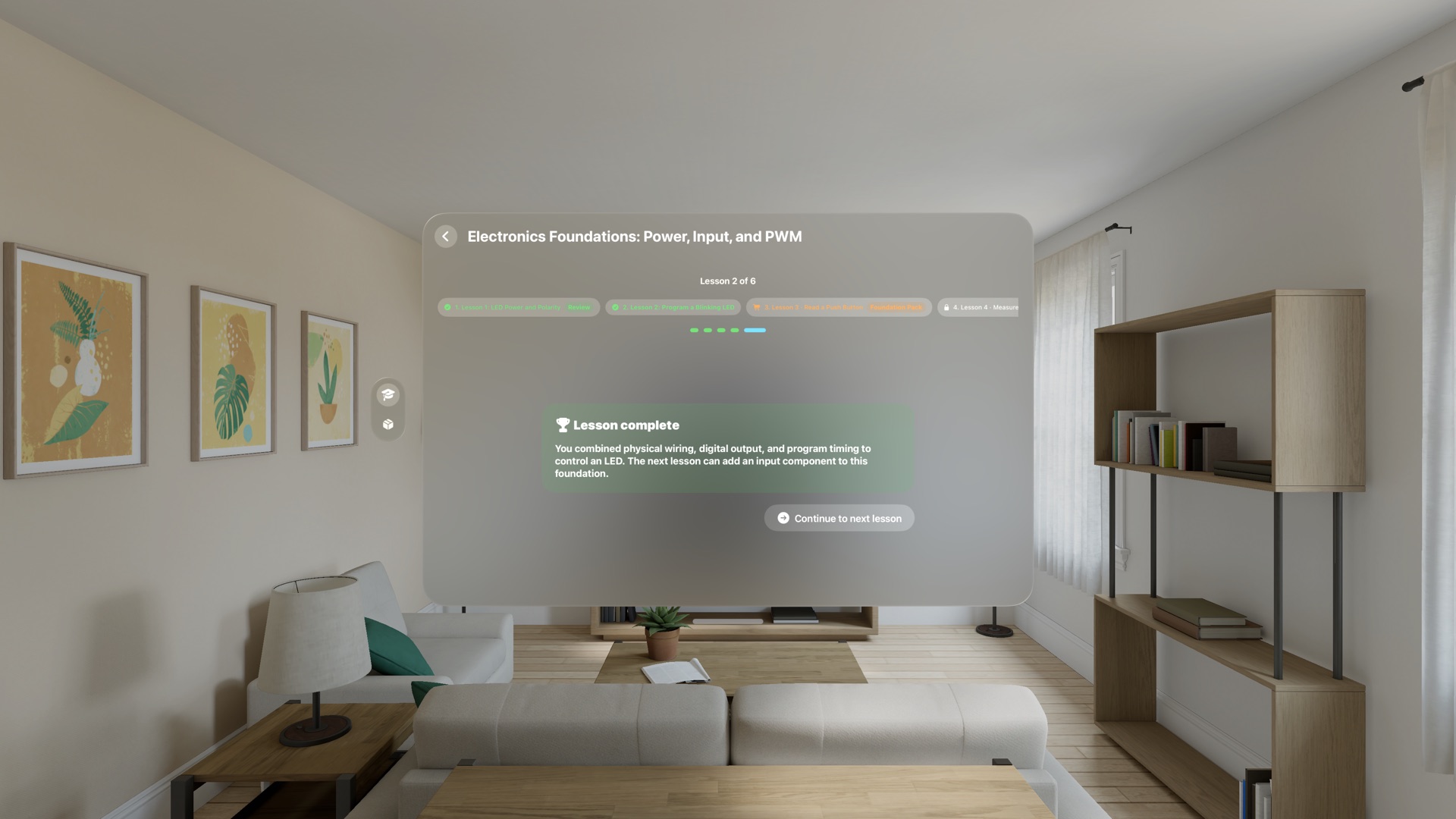
Spatial Electronics Lab showing six course units, completion status, and a continue-to-next-unit control
Six lessons share one learning path. Completed wiring, measurements, and sketches become the starting point for what follows.

Six lessons turn one LED into an environment-aware control
1 · LED Power and PolarityLearn breadboard connectivity, LED polarity, a 330 Ω resistor, and a complete current path.
2 · Program a Blinking LEDMove control to a digital pin, check a timed sketch, and upload it through the virtual USB link.
3 · Read a Push ButtonAdd a four-pin button, shared ground, and INPUT_PULLUP while learning active-low input.
4 · Measure LightBuild a photoresistor divider, compare bright and dark readings, inspect the waveform, and save a threshold.
5 · Program the Night LightCarry measured values into control logic, then verify the behavior across repeated light-and-dark cycles.
6 · Smooth Brightness with PWMMap sensor input into brightness so the LED moves beyond a binary on or off.
Multiple colored wires joining a development board and breadboard with D9, A0, GND, and 5V pin labels
Magnetic wire snapping and pin labels keep larger circuits legible. Focus, adjustable endpoints, and Undo remain available when refinement is needed.

Code Studio keeps drafts, checks, and uploads distinct

Edit or paste microcontroller-style teaching sketches. A draft never changes the circuit by itself; code is first checked against a safe subset, then runs only after an explicit upload to the virtual board. Diagnostics, serial output, analog values, and PWM telemetry place code behavior beside the result on the workbench.

Prompt Suggestions prepare course-aware text that a learner can choose to copy into an external AI tool. The app does not contact an external generative-AI service or execute arbitrary native code. Returned text is stripped of surrounding prose and Markdown, then checked locally before it can be uploaded.
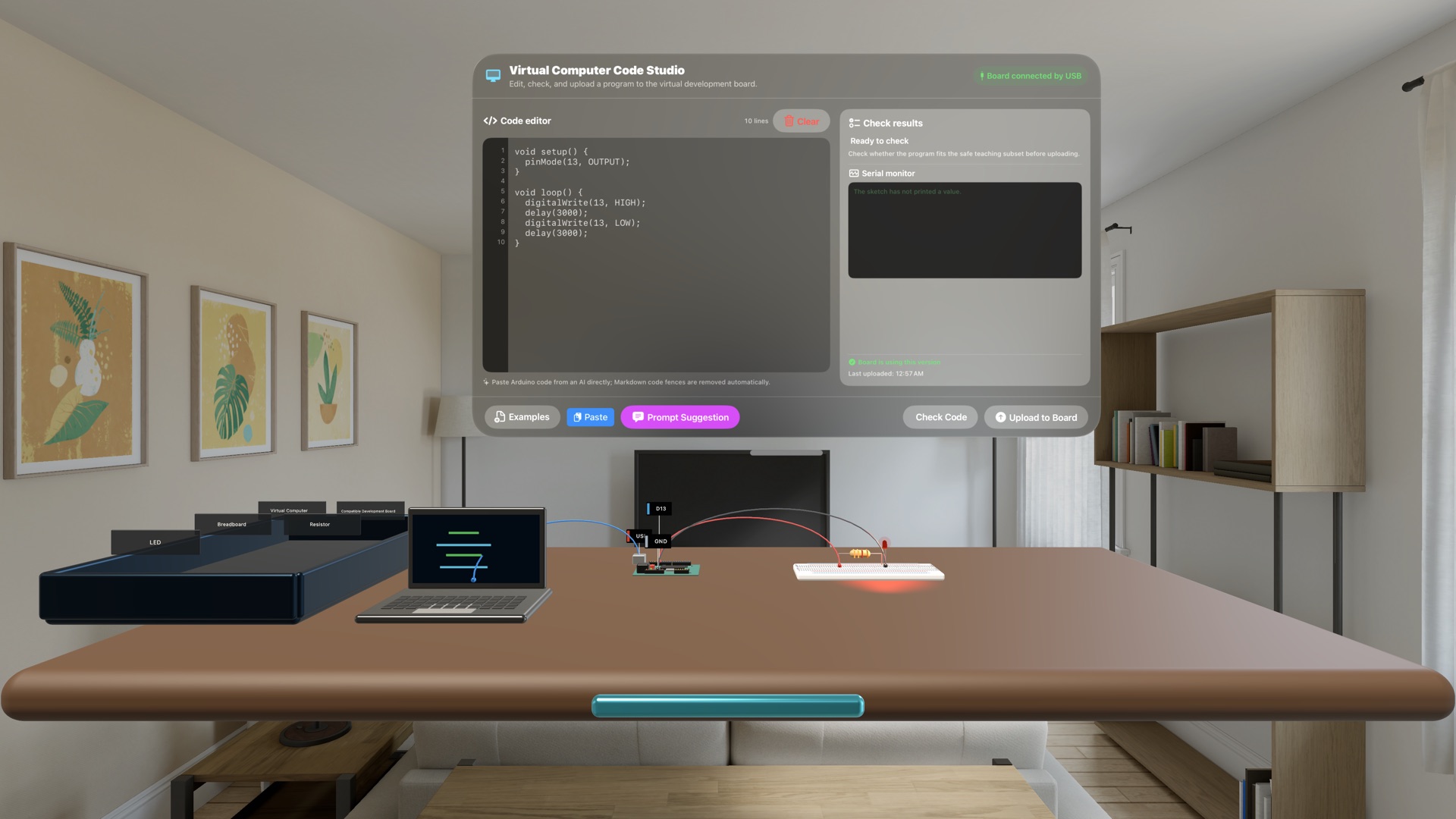
Spatial Electronics Lab Code Studio showing a sketch editor, check results, serial monitor, and upload-to-board control
Edit, check, upload, and run are separate steps, so beginners can tell a draft from the program currently controlling the board.

Buttons and sensors are experimental inputs, not static models

Press the spatial push button and the digital input and LED react directly. Move a flashlight toward or away from the photoresistor and the A0 value, threshold result, and live waveform update together. Learners must calibrate from readings they actually observe before carrying the result into the night-light sketch.
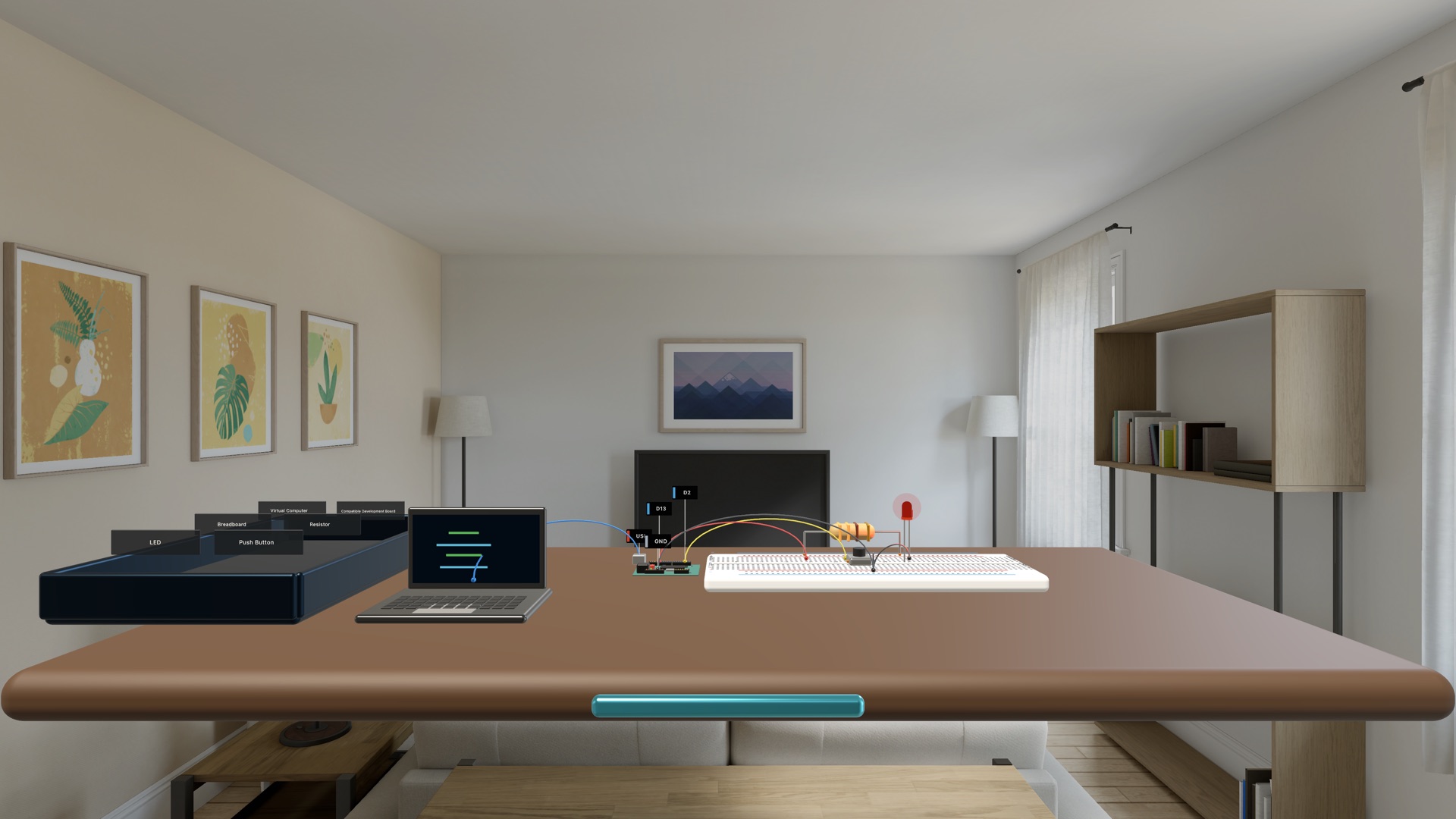
A button circuit connecting a push button, LED, resistors, breadboard, and development board in Spatial Electronics Lab
The button is a directly manipulated input linked to the digital pin, uploaded sketch, and LED output.
A flashlight illuminating a photoresistor while Code Studio shows A0 readings, calibration range, and a live waveform
The light experiment presents the spatial source, sensor, numeric result, and waveform together instead of reducing measurement to one answer.

Move from structured lessons into the Playground and 3D component library

The library includes a virtual computer, compatible development board, 830-point breadboard, jumper wires, resistors, LEDs, buttons, photoresistors, thermistors, and a servo. Rotate and magnify each 3D part while reviewing its connection points, then take materials into the open Playground to arrange a workbench and test your own ideas.
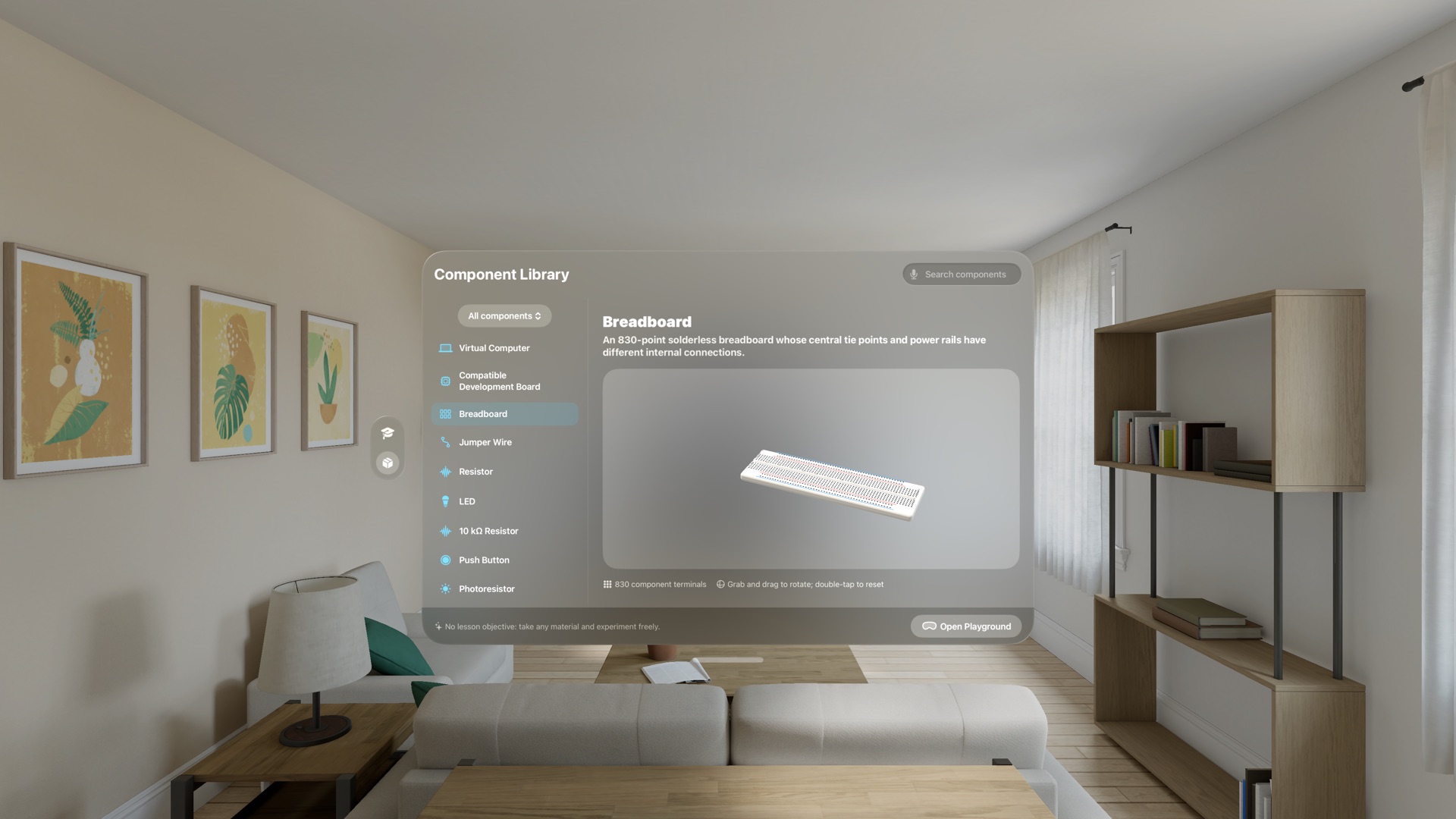
Spatial Electronics Lab component library showing an 830-point breadboard and other searchable 3D components
The library keeps names, purpose, terminals, and manipulable 3D models together, with a direct path into the open Playground.

Faults create observable and recoverable consequences

The simulator recalculates from actual terminals, breadboard connectivity, component values, uploaded firmware, and physical controls. Supply shorts, reversed polarity, floating inputs, incorrect pins, non-PWM outputs, and LED overcurrent change circuit state instead of becoming a simple answer label. Diagnostics, Focus, and Undo help learners inspect and recover. This is an educational simulation; it does not control a physical board or replace real-world electrical-safety training.

Try two lessons free, then unlock the complete foundation course once

Start freeDownload the app and complete Lesson 1, LED Power and Polarity, plus Lesson 2, Program a Blinking LED.
Foundation Course PackOne non-consumable purchase permanently unlocks Lessons 3–6 for review at any time. There is no subscription, and Restore Purchases is included.
Eleven languagesTraditional and Simplified Chinese, English, Japanese, Korean, German, French, Italian, Spanish, Brazilian Portuguese, and Russian.
Local learning dataNo account, ads, or third-party analytics. Learners, progress, circuits, and sketch drafts remain on the device.

Spatial Electronics Lab visionOS 1.0 is now available on the App Store for Apple Vision Pro. Download it free, finish the first two lessons, then decide whether to unlock the remaining foundation course with one purchase.